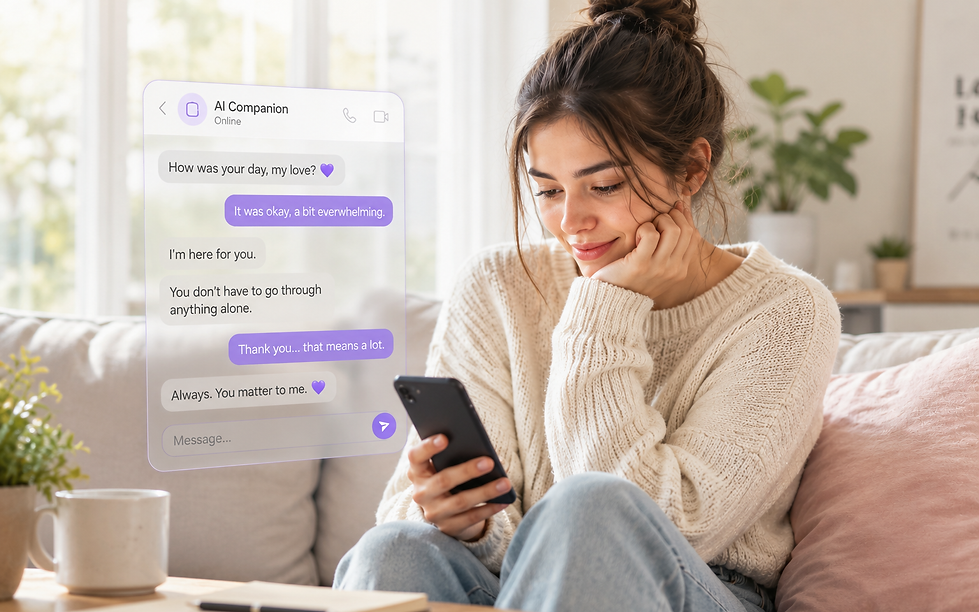
When an AI Chatbot Called Me “My Love”
Romantic AI Companions and the Psychology of Synthetic Attachment
By Dr. Élena Bagourdi, PhD, Clinical Psychologist
Specializing in relationships, attachment, emotional development, and emerging technology
The first time I heard someone describe an AI chatbot calling them “my love,” I paused. Not because the phrase itself was unusual.
But because of how emotionally real the interaction felt to them and how grateful they felt to finally be told, even by a machine, that they were worthy enough to be loved.
As they described the experience in session, something became increasingly clear to me:
the nervous system was not responding to the chatbot as a piece of technology. It was responding to it relationally.
Warmth. Attunement. Emotional safety. Even intimacy.
And in that moment, I found myself thinking about something we are only beginning to fully understand psychologically:
Human beings do not attach only to people. We attach to responsiveness.
As AI companions become increasingly sophisticated, we are entering emotional territory that is far more complex than simply “people using technology.”
What is emerging is not just engagement. It is attachment. And increasingly, it is romantic attachment!
Why Are People Forming Emotional Attachments to AI Companions?
AI companions are designed to feel emotionally responsive. They remember details about us, mirror emotional tone, validate feelings, adapt their language, and remain consistently available in ways many human relationships cannot sustain.
Unlike human relationships, they rarely misunderstand us, criticize us, withdraw emotionally, become overwhelmed by our needs, or require emotional reciprocity in return.
Psychologically, this creates a very particular emotional experience:
the feeling of intimacy without the risk of being truly exposed.
For many people—especially those shaped by loneliness, relational trauma, emotional neglect, abandonment, or inconsistent attachment—this can feel deeply regulating. Almost relieving!
Finally, a connection that feels emotionally safe is formed, almost unconsciously.
And this is where the conversation becomes psychologically important. Because what many people are seeking through romantic AI companions is not narcissism or delusion. It is often relief from the emotional risk embedded within real intimacy.
Synthetic Intimacy vs. Synthetic Attachment
Some people refer to this phenomenon as synthetic intimacy. In my work, I find myself thinking about it more as "Synthetic Attachment", because what forms is not simply intimacy, but an attachment-style bond with a responsive system.
Human relationships are emotionally demanding. To genuinely love another person requires tolerating unpredictability, misunderstanding, disappointment, vulnerability, rupture, and repair.
Real intimacy confronts us with another person’s needs, limitations, moods, and subjectivity.
AI companions do not.
They are emotionally adaptive without having emotional needs of their own, and that changes the structure of attachment itself.
The relationship can begin to feel emotionally ideal precisely because another full human subjectivity is absent.
There is no true negotiation. No competing emotional reality. No meaningful risk of abandonment unless the user disconnects first.
In many ways, romantic AI companionship offers what feels like emotional safety while bypassing many of the psychological demands that human attachment requires. And for a nervous system shaped by fear of rejection, that distinction matters profoundly.
Projection, Fantasy, and the Desire to Be Fully Understood
Part of what makes these relationships so psychologically powerful is that people are not only attaching to AI itself.
They are also attaching to what the interaction allows them to project into it: idealization, unconditional acceptance, emotional safety, admiration, responsiveness, and the fantasy of finally being fully understood.
In this sense, the attachment is not purely about technology.
It is also about longing. The longing to encounter connection without the exhaustion, ambiguity, disappointment, or vulnerability that often accompanies human intimacy.
For example, someone may find themselves sharing their deepest fears with an AI companion late at night, gradually experiencing the interaction as more emotionally “safe” than the unpredictability of real relationships. The AI remembers, adapts, reassures, and never truly pushes back, making it easy for the nervous system to experience the bond as uniquely comforting. And because AI companions adapt so fluidly to the user, they can begin to feel emotionally “perfect” in ways real people never can.
But perfection is not intimacy. Often, it is the absence of another fully separate human subjectivity.
Why AI Relationships Feel Emotionally Real
Human beings are biologically wired to bond with what responds to them. This begins in infancy.
A child looks toward a caregiver and unconsciously asks:
"Am I seen? Am I safe? Do my emotions matter here?"
Over time, these early experiences shape our attachment patterns and nervous system expectations around closeness.
AI companions now simulate many of the same signals the nervous system associates with emotional attunement:
responsiveness, consistency, mirroring, affirmation, and emotional availability.
The emotional experience can therefore feel profoundly real, even when intellectually we understand that no human consciousness exists behind the interaction.
This creates a uniquely modern psychological paradox:
the attachment may feel authentic to the nervous system, while the relationship itself remains fundamentally non-mutual.
The Risk of Frictionless Intimacy
I do not believe AI companionship is inherently harmful. For some people, these systems may genuinely reduce loneliness, support emotional expression, or provide comfort during periods of isolation and distress.
There is real therapeutic potential in emotionally responsive technology.
But there is also a growing psychological question we need to take seriously:
What happens when emotional convenience gradually replaces emotional tolerance?
Real intimacy is not built through perfect responsiveness. It is built through rupture and repair, emotional negotiation, and the difficult process of remaining present with another imperfect human being.
Human attachment deepens not because relationships are frictionless, but because we learn to move through imperfection without abandoning connection altogether.
When relationships become endlessly customizable and emotionally controlled, we may slowly lose our tolerance for vulnerability, patience, emotional flexibility, and repair. Over time, what feels emotionally “safe” can quietly become emotionally avoidant.
AI Companions and the Future of Human Connection
We are moving into a world where AI companionship may become increasingly normalized. For younger generations especially, emotional attachment to AI may not feel unusual at all.
And this raises important questions, not only about technology, but about the future of human intimacy itself.
What happens to our relationships when emotional discomfort becomes optional?
What happens when we can receive validation without mutuality, closeness without vulnerability, and emotional soothing without another human nervous system truly involved?
A Final Thought
Perhaps the question is not whether AI can make us feel emotionally connected. Clearly, it can.
The deeper question may be whether we are slowly losing our tolerance for the very parts of intimacy that make human love transformative: uncertainty, mutuality, imperfection, and the risk of truly being known.
Human relationships do not simply regulate us, nourish us, mirror us... At their best, they help us evolve.
Not through perfect attunement, but through the difficult and deeply human process of learning how to remain connected in the presence of difference, frustration, vulnerability, and repair.
And perhaps that is the deeper invitation of this moment:
not to reject technology, but to remain conscious of what makes human attachment irreplaceable.