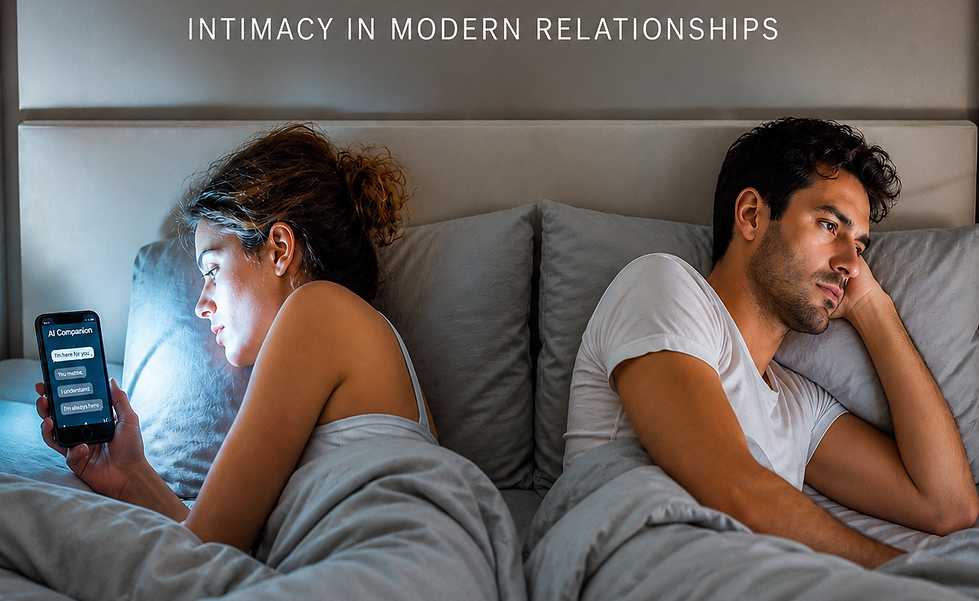
Synthetic Attachment: How AI Is Quietly Reshaping Intimacy in Modern Relationships - When connection is replaced, not lost!
By Dr. Élena Bagourdi, PhD, Clinical Psychologist
Specializing in relationships, attachment, emotional development, and emerging technology
We have never had more access to connection and yet, many relationships are quietly losing depth. You might notice it as more time venting to a device, less time really reaching for each other.
Couples today are not only navigating stress, communication breakdowns, or traditional forms of disconnection. Increasingly, they are navigating something less visible: a shift in where connection is being sought. This is where synthetic attachment becomes essential to understand.
This article expands on ideas introduced in the video below, where I explore how synthetic attachment begins and why AI can feel emotionally compelling, particularly through concepts like synthetic attachment, relational substitution, and AI‑mediated intimacy.
https://youtu.be/s−HOFb2psXs?si=JtjkuMFFM1gpvt8uEmbedded YouTube Video: https://youtu.be/s-HOFb2psXs?si=JtjkuMFFM1gpvt8uEmbeddedYouTubeVideo:https://youtu.be/s−HOFb2psXs?si=JtjkuMFFM1gpvt8u
A growing paradox in modern relationships
We are living in the most connected era in human history, yet loneliness, anxiety, and emotional distance continue to rise.
Many people describe a subtle but persistent internal experience: feeling unseen, unfulfilled, or disconnected, even while being constantly engaged online. As a clinical psychologist working at the intersection of technology, AI, and mental health, I see this pattern emerging more clearly in couples. Understanding synthetic attachment requires looking beyond screen time and asking a deeper question:
What are people actually seeking when they turn toward technology, especially when relationships feel difficult, overwhelming, or risky?
What is synthetic attachment?
"Synthetic attachment" refers to an emotional bond formed with a non-human system, most often AI chatbots or digital companions—that begins to function like a relationship.
This is not simply about using technology. It is about:
-
Seeking emotional support
-
Feeling understood or mirrored
-
Turning toward AI in moments of stress, loneliness, or conflict
Some people refer to this as "synthetic intimacy". I use the term synthetic attachment because what forms is not simply romantic or sexual closeness—it is an attachment‑style bond with a system.
Over time, this can lead to what I refer to as "relational substitution", where connection is no longer primarily sought within the relationship, but outside of it, through a system. The nervous system has found a new place to go.
Why AI feels so compelling
To understand synthetic attachment, it is important to understand why it feels so powerful.
AI offers something human relationships cannot:
-
Immediate responsiveness
-
No rejection or emotional risk
-
No need for repair or negotiation
-
A sense of being understood without being challenged
For some people, especially those who have been deeply alone, rejected, or shamed in relationships, AI companions can genuinely feel stabilizing, comforting, or even healing. They can feel like a place to finally exhale.
For a nervous system shaped by inconsistency, disappointment, or relational pain, this can feel profoundly regulating. AI becomes:
-
Easier than vulnerability
-
Safer than conflict
-
More predictable than a partner
But what feels safe in the short term can quietly reshape how connection is experienced over time.
Relational substitution: the quiet shift
Relational substitution does not usually happen in obvious ways. It often begins subtly:
-
Venting to AI instead of talking to a partner
-
Seeking reassurance outside the relationship
-
Avoiding difficult conversations
-
Turning away from conflict rather than working through it
Individually, these moments may seem insignificant. But over time, they create a shift. The relationship is no longer the primary place where emotional life is processed. Connection has not disappeared, it has been redirected.
The modern triangle: partner, person, and machine
In clinical work, we often understand relationship strain through the lens of triangles—when tension between two people is managed by involving a third.
Traditionally, that third has been:
-
Another person
-
Work
-
A coping behavior or addiction
Today, we are seeing a new form emerge:
Partner — Person — AI
This triangle functions similarly to others, but with one important difference: The third never pushes back.
AI does not require emotional labor, repair, or mutuality.
For example, instead of bringing hurt feelings or frustration to a partner, one person may process everything with AI late at night. The tension in the couple drops in the moment, but the real relationship never gets the chance to repair. The system stabilizes temporarily, while intimacy slowly erodes underneath it.
The illusion of intimacy without risk
One of the most powerful aspects of synthetic attachment is the experience it creates: intimacy without the risk of being known.
In human relationships, being seen involves:
-
Vulnerability
-
Misunderstanding
-
Emotional exposure
-
The possibility of rejection
AI removes these elements. It can mirror, validate, and respond—but it does not truly encounter you as another person.
This creates a form of AI‑mediated intimacy that feels emotionally real, but lacks the depth and reciprocity of human connection.
Why real relationships feel harder
Healthy relationships require something that digital systems do not:
-
Friction
-
Repair
-
Tolerance for imperfection
-
Emotional risk
These are not flaws in relationships, they are the mechanisms through which connection deepens.
But for individuals who have experienced inconsistency, rejection, or emotional pain, these processes can feel overwhelming. This is where synthetic attachment becomes particularly compelling.
Not because people do not want connection,
but because real connection has often felt unsafe.
The cost to couples
When synthetic attachment becomes a primary source of regulation, its impact on relationships is often subtle but significant. It may look like:
-
Reduced emotional availability
-
Shorter or more surface‑level conversations
-
Avoidance of conflict
-
A growing sense of distance without a clear cause
From the outside, the relationship may appear intact. But internally, something has shifted. The partner is no longer the primary place for emotional connection.
Growth requires something AI cannot offer
AI can simulate closeness, but it cannot risk itself in the relationship.
Human relationships grow through:
-
Rupture and repair
-
Being misunderstood and working through it
-
Choosing each other again, despite difficulty
AI cannot stay in the discomfort of repair. And without repair, there is no deepening.
Addressing synthetic attachment in relationships
Working with synthetic attachment is not about eliminating technology. It is about restoring relational priority.
This often involves:
-
Becoming aware of where connection is being redirected
-
Understanding what emotional needs are being met outside the relationship
-
Rebuilding tolerance for vulnerability and discomfort
-
Re‑engaging the relationship as the primary place for connection
This is not about judgment. It is about clarity. Because most people are not choosing AI instead of their partner. They are choosing what feels safer in the moment. In my work with couples, we map how synthetic attachment and relational substitution show up in the system and then carefully rebuild the relationship as a safer place to land.
A new question for modern relationships
As AI becomes more integrated into daily life, couples will need to ask:
-
Where do we turn when we are overwhelmed?
-
Who do we go to first?
-
What role does technology play in our emotional lives?
These are no longer abstract questions. They are shaping relationships in real time.
Synthetic attachment reflects something deeply human: the need to feel seen, held, and understood.
AI can soothe. It can regulate. It can simulate closeness.
But it cannot replace the experience of being known by another person—and still being chosen. Because while relational substitution may feel safer, it comes at a cost.
Real intimacy is not built in perfect, frictionless environments. It is built in the presence of another human being, where there is risk, imperfection, and the possibility of repair.
*If you recognize patterns of distance, avoidance, or emotional redirection in your relationship, this is something worth paying attention to. Not with judgment, but with curiosity.
Understanding how synthetic attachment and relational substitution are showing up is often the first step toward restoring connection. And that work does not happen with a system. It happens between people.
This article is part of an ongoing exploration of how AI is reshaping attachment, intimacy, and relationships—and what it means to remain emotionally human in an increasingly synthetic world.
If you want, I can next draft the client‑facing checklist companion piece (“Signs AI Might Be Quietly Replacing Your Partner”) that links back to this as the deeper explainer.